
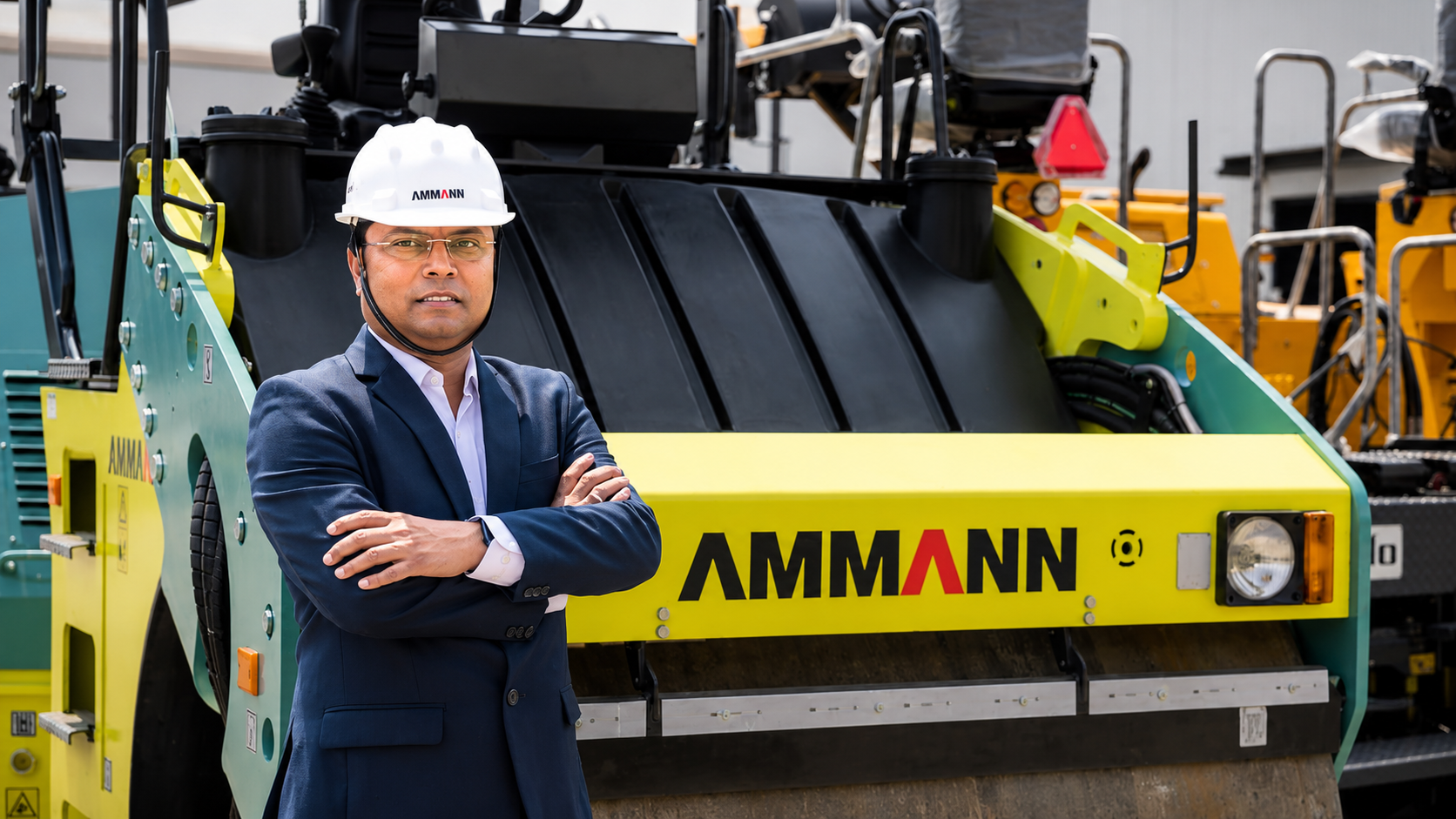
Redeveloping India’s urban infrastructure will demand a new generation of construction equipment designed for compact worksites, smarter operations and sustainable development. Dheeraj Panda, Managing Director, Ammann India, explains why the industry’s future lies in technology-driven, environmentally responsible solutions.
Urban Redevelopment Will Fundamentally Change How Construction Happens in India
If you look at India’s infrastructure journey over the last two decades, much of the focus has been on creating new assets. Over the next decade, however, I believe the bigger opportunity will lie in transforming what already exists and building differently, sustainably.
India’s ageing roads, urban transport systems, industrial zones and public infrastructure will require extensive modernisation. At the same time, brownfield redevelopment is gaining momentum as cities face increasing pressure to optimise land use, improve mobility and create more sustainable urban environments. This shift will have a profound impact on construction equipment demand.
Unlike greenfield projects, urban redevelopment happens in highly constrained environments. Contractors must work within active cities, manage traffic, minimise disruptions and deliver projects within tighter timelines. As a result, the industry will increasingly demand equipment that is compact, intelligent, efficient and environmentally responsible.
This trend is particularly significant given that Tier 2 and Tier 3 cities today contribute nearly 40 to 45 percent of India's GDP and are becoming major infrastructure investment destinations. Combined with initiatives such as PM Gati Shakti and Smart Cities Mission, we expect redevelopment activity to become a major growth engine for the construction equipment industry. Industry estimates already indicate that the Indian construction equipment market could grow at 11.91 annually through FY2032.
The Future Is Smarter Machines
One of the biggest misconceptions is that infrastructure growth automatically translates into larger equipment demand. Urban redevelopment is changing the nature of equipment requirements.
The question is no longer how powerful a machine is. The question is how efficiently it can operate in a dense urban environment, with making optimum use of new or recycled materials with lower emissions and energy consumption.
We are seeing growing demand for compact equipment with superior manoeuvrability, modular plants that can be mobilised quickly, and paving and compaction technologies that deliver precision with minimal disruption. Equipment operating in cities must do more with less space, less time and increasingly, with lower environmental impact.
Technology Will Be the Differentiator
The next decade will belong to contractors who can build faster, smarter and more predictably. Digitalisation is already reshaping the industry. Connected equipment, predictive maintenance and intelligent control systems are helping contractors maximise uptime and improve operational efficiency. When project delays can have significant economic consequences, technologies that predict equipment issues before they occur become extremely valuable.
Equally important is the rise of data driven construction. The future worksite will be connected end to end, with equipment, material production, project planning and performance monitoring operating as part of a single ecosystem.
In my view, this transition will be as transformative for construction as automation has been for manufacturing.
Sustainability Is Moving from Aspiration to Expectation
Urban redevelopment is not only about renewing infrastructure. It is about building cities that are cleaner, more resilient and future ready. This is accelerating demand for electric equipment, low emission technologies and solutions that support circular construction practices. Technologies that enable the use of reclaimed asphalt and recycled materials are becoming increasingly important because they help cities reduce waste while conserving natural resources.
The conversation has evolved beyond sustainability as a compliance requirement. Today, sustainability is becoming a business imperative that improves efficiency, lowers lifecycle costs and enhances long term project viability.
A Decade of Opportunity for the Industry
For equipment manufacturers, the opportunity is substantial. India is emerging as one of the world’s fastest growing construction equipment markets and at the same time as a strategic manufacturing hub.
At the same time, the industry must address important challenges, particularly around affordability, skill development and technology adoption. Advanced machines require advanced capabilities, and bridging the skill gap will be critical to unlocking the full potential of modern equipment.
The next phase of growth for the construction equipment industry will be driven by its ability to serve as a partner in building smarter, safer and future ready infrastructure.
India’s urban transformation is already underway. The cities we build over the next decade will define the country’s economic competitiveness for generations, and construction equipment will be one of the key enablers of that transformation.


